Modular autonomous transit systems (MATS) present a promising direction for the advancement of urban mobility due to their
remarkable ability to flexibly allocate capacity across both spatial and temporal dimensions. Although scholars have
extensively explored optimizing the coupling and decoupling of modules and creating adaptable service strategies for MATS, the
capacity for modules to overtake has largely been neglected, which could reduce MATS efficiency. In this paper, we introduce a
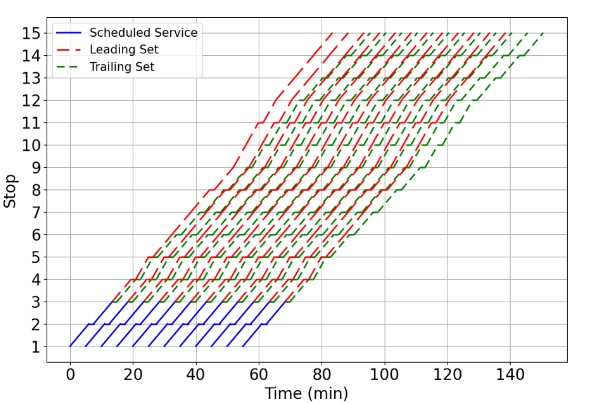
novel operational strategy allowing certain modules to detach from their scheduled trip and, by bypassing stops, create an
unscheduled express service, thus leading to an en-route express service. The potential overtaking actions of both decoupled
and non-decoupled modules, due to skipping stops, and passengers transfer within the module, add significant complexity to the
model. To address this, we develop a mixed integer nonlinear programming (MINLP) model with an objective to minimize the total
cost for both passengers and the operator of the transit system, and we determine optimal decoupling/coupling strategies and
schedules for the en-route express services. To enhance computational efficiency, we recast the original nonlinear model into a
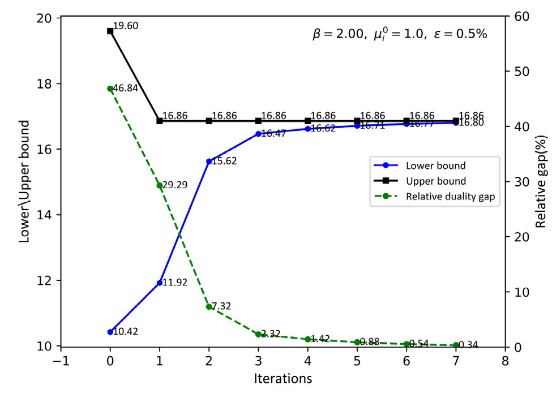
mixed integer quadratic program (MIQP) and introduce an outer approximation (OA) algorithm to solve it effectively. The results
of our illustrative and large-scale experiments reveal that the proposed OA algorithm significantly enhances computational
efficiency compared to CPLEX solvers. Compared to two benchmark systems with fixed capacity buses—local (all-stop) service and
stop-skipping service, the proposed en-route express service reduces the total cost by 15.1% and 12.9%, and lowers the average
passenger service time cost by 19.7% and 33.8%, respectively, underscoring the advantages of the en-route express service for
MATS. These findings contribute to the development of more efficient MATS operations by introducing an en-route decoupling
strategy that leverages overtaking capabilities to create adaptive express services. The work highlights the significant
potential and importance of developing urban mobility systems that are more adaptable and responsive to urban travelers, while
optimizing the utilization of available resources.
@article{xiao_optimization_2026,chapter={105535},title={An optimization model for en-route express service scheduling in modular autonomous transit systems},volume={184},doi={10.1016/j.trc.2026.105535},language={en},journal={Transportation Research Part C: Emerging Technologies},author={Xiao, Shuyan and Zhang, Yufeng and Yang, Lixing},month=mar,year={2026},%url={http://link.aps.org/doi/10.1103/PhysRev.47.777},dimensions = {pub.1111438160},}
2024
TR-Part A
Comparative Analysis of Usage Patterns and Underlying Determinants for Ride-hailing and Traditional Taxi Services: A Chicago
Case Study
Zhiqi Wang, Yufeng Zhang, Bin Jia, and
1 more author
Transportation Research Part A: Policy and Practice, Jan 2024
As app-based ride-hailing (or e-hailing) services have achieved great success worldwide, the traditional taxi industry faces
an unprecedented crisis. To gain a deeper understanding of these two distinct modes that both offer door-to-door mobility
services, in this study, we use Chicago as a case to comparatively analyze the travel patterns of the app-based ride-hailing
and traditional taxi services and understand how socio-demographic and urban land use attributes affect the usage of two
services in temporal and spatial dimensions. We employ the local regression models named geographically and temporally
weighted regression (GTWR) models that can capture the spatiotemporal nonstationarity between variables as the primary
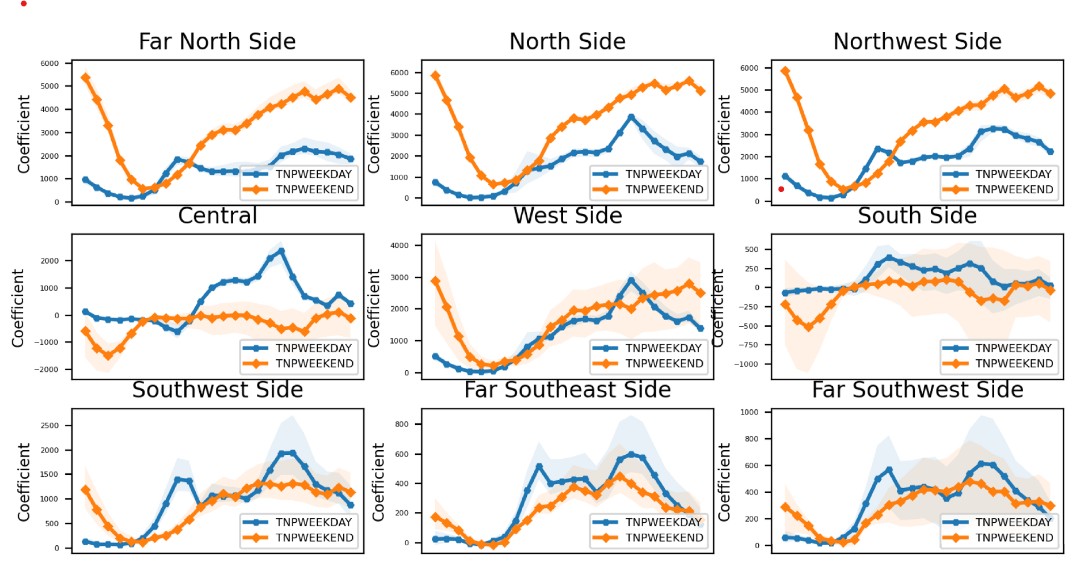
analysis tool. Four GTWR models that predict the average hourly taxi or ride-hailing trip volume on weekdays or weekends for
each community area are carefully constructed with R^2 all above 0.98. The nonstationarity test shows all variables exhibit
extra local variations, indicating the necessity of using the GTWR models to explore the attributes’ spatiotemporal impacts.
Spatial error models (SEM) and ordinary least square (OLS) models, global regression models, are also built as comparisons and
benchmark references. The differences between global and local regression models are illustrated through clustering analysis.
To compare and contrast the usage patterns of ride-hailing and taxi services, we analyze the temporal-spatially varying
coefficients of GTWR models. Interpretations are provided for our interesting findings, including the strong trip generation
power of the population in the South Side area, the attitude of white people towards taxi services is positive but ambiguous
towards ride-hailing services, young people’s opposing behaviors towards taxi services on weekdays and weekends, and the
opposite relationship between transit and taxi or ridehailing in certain areas. Based on these key findings, we offer some
planning and operational suggestions, such as developing mobile apps, implementing price-related strategies, strengthening
partnerships with local businesses, building multi-modal transportation, clarifying customer segmentation, providing auxiliary
services, etc.
@article{wang_comparative_2024,title={Comparative {Analysis} of {Usage} {Patterns} and {Underlying} {Determinants} for {Ride}-hailing and {Traditional} {Taxi} {Services}: {A} {Chicago} {Case} {Study}},volume={179},issn={09658564},shorttitle={Comparative {Analysis} of {Usage} {Patterns} and {Underlying} {Determinants} for {Ride}-hailing and {Traditional} {Taxi} {Services}},url={https://linkinghub.elsevier.com/retrieve/pii/S0965856423003324},doi={10.1016/j.tra.2023.103912},language={en},urldate={2024-09-18},journal={Transportation Research Part A: Policy and Practice},author={Wang, Zhiqi and Zhang, Yufeng and Jia, Bin and Gao, Ziyou},month=jan,year={2024},pages={103912},dimensions={pub.1166608031},}
2019
TR-Part B
An algorithm for reliable shortest path problem with travel time correlations
Yufeng Zhang and Alireza Khani
Transportation Research Part B: Methodological, Mar 2019
Reliable shortest path (RSP) problem reflects the variability of travel time and is more realistic than standard shortest path
problem which considers only the average travel time. This paper describes an algorithm for solving the mean-standard
deviation RSP problem considering link travel time correlations. The proposed algorithm adopts the Lagrangian substitution and
covariance matrix decomposition technique to deal with the difficulty resulting from non-linearity and non-additivity of the
Mixed Integer Non-Linear Program (MINLP). The problem is decomposed into a standard shortest path problem and a convex
optimization problem whose optimal solution is proved and the Lagrangian multipliers ranges are related to the eigenvalues of
the covariance matrix to further speed up the algorithm. The complexity of the original problem is notably reduced by the
proposed algorithm such that it can be scaled to large networks. In addition to the sub-gradient Lagrangian multiplier
updating strategy integrated with projection, a novel one based on the deep-cut ellipsoid method is proposed as well.
Numerical experiments on large-scale networks show the efficacy of the algorithm in terms of relative duality gap and
computational time. Besides, there is evidence showing that, though having longer computational time, the ellipsoid updating
method tends to obtain better solutions compared with the sub-gradient method. The algorithm outperforms the existing
one-to-one Lagrangian relaxation-based RSP algorithms and the exact Outer Approximation method in the literature.
@article{zhang_algorithm_2019,title={An algorithm for reliable shortest path problem with travel time correlations},volume={121},issn={01912615},url={https://linkinghub.elsevier.com/retrieve/pii/S0191261518302959},doi={10.1016/j.trb.2018.12.011},language={en},urldate={2022-10-25},journal={Transportation Research Part B: Methodological},author={Zhang, Yufeng and Khani, Alireza},month=mar,year={2019},pages={92--113},dimensions={pub.1111438160},}
 An optimization model for en-route express service scheduling in modular autonomous transit systemsTransportation Research Part C: Emerging Technologies, Mar 2026